As our drought continues, so do worries about where the feed will come from to get cows through to better times. The drought of 2026 started in the fall of 2025, and there has been very little rain since that time. Many areas are 15 to 20 inches behind on rain for the year! The development of this situation took some by surprise as in winter it only takes a little bit of moisture to give you mud. Also, rainfall is more effective in cooler weather, so timely rains in March pushed out growth of pastures and made things seem better than they were. If you keep track of your rainfall, you could see this coming for a long time.
Unfortunately, periods of warm weather pushed out early pasture growth that was subsequently damaged by late freezes. As a result, pastures and hayfields showed delayed growth, which was then challenged by very high temperatures. That green up and freeze off cycle happened two or three times for many of us, so that by the time things really should have started to grow strong in April and May, the lack of moisture became an obvious reality.
At this point, much of the pastureland in the region has been closely grazed and many cows are being fed hay. The very short first cutting hay crop (25 to 50% of our normal expectation) makes this situation even more dire. Some farmers have also kept more cows than usual due to the high prices they expect for calves, and now that feed is short this may not have been a good plan. Recent rains, especially in the mountains, have relieved some minds, but even if things are green where you are it will take a lot of continued rain to get us out of the drought, and we will not recover that lost spring hay production no matter what.
I have received many calls and emails in the last week asking about various alternative feeding strategies. Even if we receive a lot of rain by the time this article is published, we will be in a hay shortage until at least next spring, so every producer needs to take stock of their situation and make sure they have a feed plan for the number of cattle they intend on keeping.
Fortunately, cattle prices are high, so we need to take advantage and market cattle that are ready for sale. In an earlier cattle connection article, we discussed culling in the face of drought, so keep in mind that is the first step in your plan; reduce the total amount of feed that will be needed. Selling in an orderly fashion will help you keep the very best cows and replacement heifers so you can build back after the drought runs its course. If you still have cows that have significant defects they should be sold now. Later, if things continue to worsen you can start selling the good cows that don’t need to go to slaughter.
Alternatives to local hay for beef cows
While we all wish we had enough good hay on hand or in the local area to feed our cows, that is not going to be the case for many of us this year, so consideration of alternatives needs to start now. Alternative feeds for this situation may include alternative forages and roughages, concentrates, and other unusual and underutilized feeds. Each producer needs to consider their own situation, make a feed budget and then lay in the amount of feed they expect to need for the rest of the summer and winter. The sooner you do this the better you will feel, and the better off you will be when the feed shortage worsens.
Currently there is a little hay around no matter where you are, so farmers are encouraged to find it and get it bought now. Many of my regular hay suppliers I have checked with had a very poor first cutting, and as most of them have their own cows they don’t want to sell any hay until they see what will happen with future rain. I hope I get some of the hay we usually can count on, but for now we need to assume that we won’t.
If you are searching for hay, check out NC Hay Finder, a free matching service developed by NC State Extension during the response to Hurricane Helene. You can enter your zip code and the tool will help you locate hay near your location. If you must move hay a long distance the delivery cost will be high, but that still may be your best option.
All purchased hay should be tested for nutritional value and nitrate. There will be some hay available from hog and poultry farms that use a high level of fertility to produce forages, especially if we get some more timely rains. Keep in mind that if your cows are not adapted to nitrate, they could be hurt by hay that would normally not be a problem where it is grown, because most cows there are adapted to nitrate. A forage test is your best way to make sure you follow established guidelines for feeding high nitrate hay.
Feeding cows concentrates
Concentrate feeds like corn and grain processing byproducts can be fed to beef cows with careful management. For example, a 1,200-pound dry cow can be maintained on about 15 pounds of corn and 5 pounds of hay per day (plus a good quality mineral free-choice). Other concentrates like corn gluten feed, whole cottonseed, or soybean hulls can also be utilized if you observe established feeding limits (such as with whole cottonseed). There is a lot of research with this approach, and for many producers it will prove a more economical option than feeding hay hauled in from a great distance.
One problem with feeding concentrates to brood cows is that even though the cattle are receiving plenty of nutrients they will not feel “full” and they will be hungry, noisy and generally unhappy. It takes a good fence to keep these “hungry” cows contained, so keep that in mind. Also, they will be very aggressive when you feed, so make sure you have plenty of bunk space and stay safe when you are on the ground with the cows pouring feed into troughs.
Alternative forages and roughages
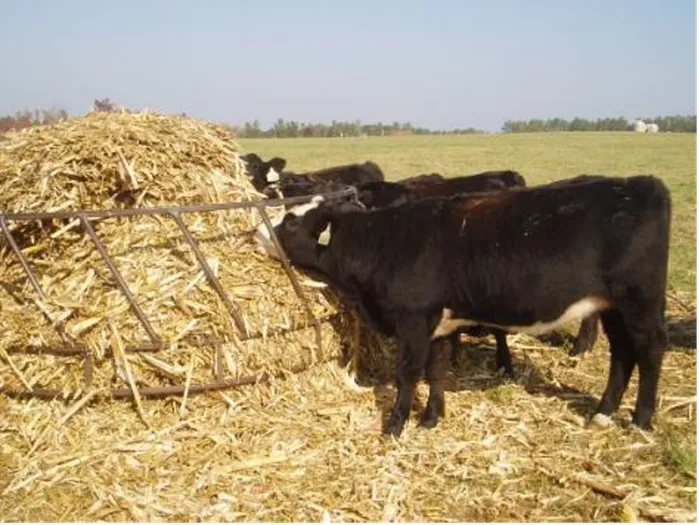
Beef cows can be fed on forages not usually considered including; corn, sorghum and small grain silages; crop residues like corn stover and wheat straw; and salvaged crops including soybean forage, corn “hay” and other crops that may not have enough value to warrant normal harvest. In most years there is a good supply of corn silage in fall and winter that can be purchased. For now, we are early in the drought with time left for a good corn and soybean crop if it does rain. If the dry weather continues to challenge these crops, they may be available as salvage forages later this summer. Many crop farmers don’t have the equipment to harvest forages, so keep in touch with your local Extension agent to learn about opportunities to salvage crops in your area.
Often, row crops will be covered by crop insurance, and there are provisions for salvage that involve leaving a check strip to determine what yield would likely have been and then harvesting the remainder while it still has good value. Like with other drought impacted forages, nitrate could be an issue, especially with corn hay or stover, so make sure all feeds are tested before feeding.
I have talked to several farmers that have already hauled hay from a long distance (PA and MS) to make sure they have some on hand. As you look at that alternative make sure you consider the high freight cost and the fact that it is always risky to buy hay sight unseen.
Other unusual or otherwise underutilized feeds
There are other local alternatives that may be attractive in specific areas. These include food and beverage processing byproducts (like vegetable processing waste and brewer’s grains). Be aware that many of these sources are already used by local farmers as they have a high value and usually a very low price. Also, making a mix with dry ingredients often is the best way to utilize these materials.
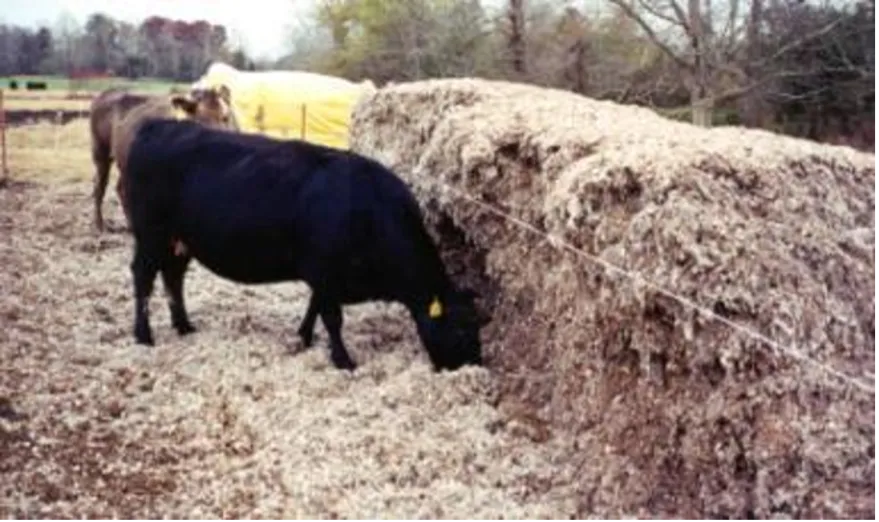
Cotton gin byproduct (formerly known as gin trash or cotton burrs) is one of the few alternatives that is still not commonly fed, but that is increasing in interest. Only about half of this material is used for cattle feed, so it is officially an underutilized material. We have been conducting research with this material for growing cattle at NC State in recent years, and we have a long history of experience with it as a feed for brood cows. It is well accepted by cows either in large modules, in smaller bales, or in the loose form. The loose material is much more economical near the source of production, but most producers find the baled byproduct is easier to handle and feed.
Producers with a TMR wagon will find that cotton gin byproduct can be used as a part of a TMR with great success, especially when the diet contains some wet ingredient to help control dust. Feeding up to 40% of the diet for growing stocker cattle appears to be acceptable, and for heifers being fed for a lower rate of gain up to 60% of the diet seems to work well. In practice brood cows can be provided free-choice cotton gin byproduct along with limited hay and an energy supplement and do quite well.
Recycled Poultry Bedding (formerly known as deep stacked poultry litter) has been widely researched as a feed for beef cows. The material makes a remarkably good feed when it is supplemented with energy (corn) and some hay or other roughage. When processed as recommended it is a safe and nutritious source of protein, minerals and energy.
Recycled Poultry Bedding is made when litter is removed from the poultry house and then “deep-stacked” with a plastic cover to keep it from overheating. The stack will go through a heat which kills pathogens and improves the palatability to cattle.
There is a misconception that this material has been banned as a feed for beef cattle. That is not the case, and this material, commonly known as “RPB” is a legal feed described by the Association of American Feed Control Officials (AAFCO). While it is no longer commonly discussed, there is still some feeding of this material. In general, it is something we don’t talk much about because many in and outside of the beef industry find it distasteful. In a situation like we are in it may be something to consider if you have poultry houses or are in a poultry producing area. This would be especially useful if you have a TMR wagon and can mix it with several other ingredients.
Finally, there may be opportunities for grazing on neighboring forest or cropland. Consider the feed that might be in the woods on your farm or neighboring farms. Cows can make use of brush, tree leaves, and other weeds that may be on land that you can access using temporary fence technology. Also, there may be opportunities to glean crop fields including cotton, corn and soybean fields. This will be an opportunity later in the year as we find out more about how crops will do in these dry conditions. When grazing in unfamiliar areas make sure you study the plants present and make sure there are no toxic weeds that the cows might consume.
SUMMARY:
For now, we should continue to pray for rain. If we get back to some pretty good rainfall before midsummer, then the drought feeding plan may be focused on wintertime. If it doesn’t rain soon, we will need to start feeding cows when the pastures are too short to adequately feed the animals. Some alternatives like Cotton Gin Byproduct may still be available from last year, but expect that opportunity to pass quickly. Hay being advertised will be expensive and quick to sell, so act fast and make sure you don’t miss good local opportunities. Make sure you have some feed on hand once the pastures play out so you keep your animals in good condition. If things worsen make sure you continue to follow a staged marketing plan and do what you can to preserve the most important genetic resources you have.